

As a marginalized group, prisoners often face isolation from society. Combined with the opacity of the carceral system, prisons can become places prone to abuses. To prevent such situations, a robust framework of international standards has been established. However, while numerous instruments protect prisoners’ rights, many mainly focus on broader human rights principles or judicial guarantees and do not adequately address the specific challenges faced by incarcerated individuals.
To directly address these challenges, the United Nations General Assembly adopted the Mandela Rules in 2015, a revised version of the Minimum standards for the treatment of prisoners, first adopted in 1955. These rules, named after the late South African President Nelson Mandela, cover a wide range of categories, including specific provisions regarding the accommodation of prisoners or the provision of food and water, which, for instance, must not be used as disciplinary measures. The rules also provide that prisoners’ health must be adequately taken care of and that contact with the outside world must be guaranteed. Rehabilitation and reintegration are also an integral focus of the minimum standards, and prisons must have dedicated programs aiming towards their achievement.
To increase understanding of prisoners’ rights, Mr Thanousinh Morada conducted an open lecture on the current international standards for prisoners’ rights at the Faculty of Law and Political Science. He provided an overview of key legal instruments, including the Universal Declaration of Human Rights, the International Covenant on Civil and Political Rights, the Body of Principles for the Protection of All Persons under Any Form of Detention or Imprisonment, and more specifically, the Mandela Rules. The lecture also explored the available framework protecting prisoners rights in the Lao PDR compares, focusing on the Law on Criminal Procedure and the Penal Code.
Universally recognized as the global benchmark for prisoner treatment since their initial adoption in 1955, the minimum standards have generated prison management reforms worldwide. Further refined and expanded by the Mandela Rules in 2015, these standards set a rigorous benchmark for prisoners’ rights and continue to shape national legislation, fostering a more humane approach to incarceration globally.
Mr. Thanousinh Morada examined specific provisions of the minimum standards, discussing issues they aim to address, such as overcrowding, health issues, women prisoners and the challenge of reintegrating prisoners back to society.

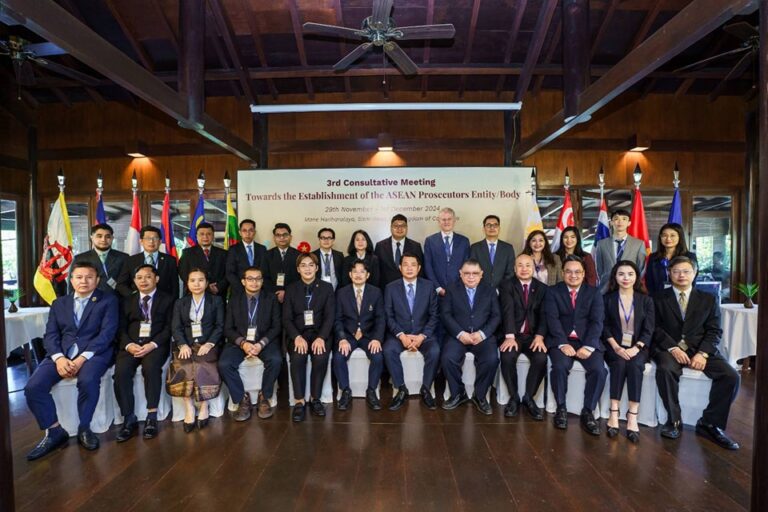
Third Consultative Meeting to Establish the ASEAN Prosecutor Body/Entity
Mr. Jumpon Phansumrit, Deputy Attorney General, along with a delegation from the Office of the Attorney General of Thailand, participated in the Third Consultative Meeting to Establish the ASEAN Prosecutor

