

Public international law is a body of international rules for States and other subjects of international law.
Article 38 of the Statute of the International Court of Justice, the highest international court for international disputes located in The Hague, defines the sources of international law as follows: a. international conventions; b. international custom, as evidence of a general practice accepted as law; c. the general principles of law recognized by civilized nations; d. […] judicial decisions and the teachings of the most highly qualified publicists of the various nations.
Public international law provides a clear and predictable legal framework for international relations and contributing to stability and conflict prevention, as well as overcoming common challenges. Public international law is crucial to the national system as international conventions ratified by a country prevail over national laws. As such, laws that are not aligned with international conventions must be revised in order to comply with international standards.
Ms Alexis Thuret gave an open lecture on public international law at the Faculty of Law and Political Science in Vientiane.
In order to understand the objectives and challenges of public international law, the lecturer presented the actors on the international scene and the way in which they interact with each other in the development of international legal standards. She also outlined the various sources of international law. Finally, the lecturer presented the process of drafting and implementing an international convention with regard to these actors and sources. She also emphasised the advantages of implementing such a convention, which develops cooperation and mutual trust between States.

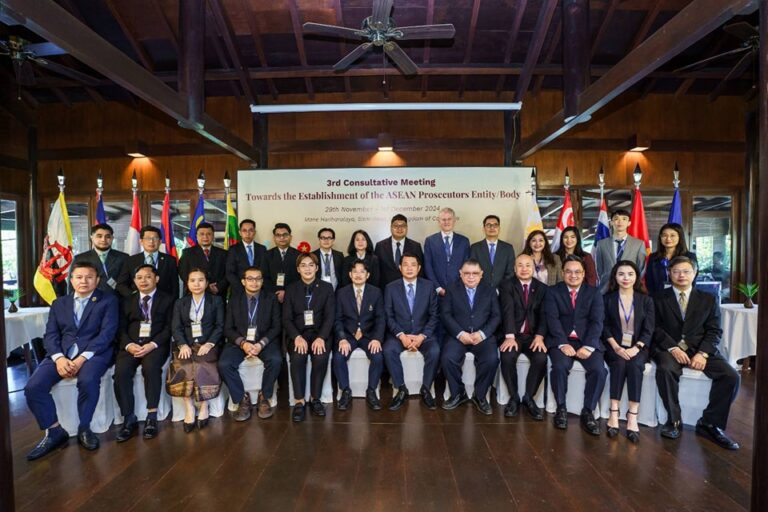
Third Consultative Meeting to Establish the ASEAN Prosecutor Body/Entity
Mr. Jumpon Phansumrit, Deputy Attorney General, along with a delegation from the Office of the Attorney General of Thailand, participated in the Third Consultative Meeting to Establish the ASEAN Prosecutor

