

Human Trafficking is Modern-day slavery
Despite the existence of the international legal framework and domestic legislation, millions of children, women, and men continue to fall victim to human trafficking every year, all over the world, including in Lao PDR.
Ms Neïla Mebtoul, Programme Officer at ILSTA, held an open lecture on trafficking in persons at the Faculty of Law and Political Science in Vientiane.
Trafficking in persons generally refers to the process through which persons are placed or maintained in a situation of exploitation by means of threat or use of force or other forms of coercion for economic gain.
The key instrument to combat is the Penal Code transposing the Protocol to Prevent, Suppress and Punish Trafficking in Persons, Especially Women and Children, supplementing the United Nations Convention against Transnational Organised Crime (UNTOC). It provides the first internationally accepted definition of trafficking in persons and binds the states to consider trafficking in persons as a serious offence in their domestic law. Exploitation, the central element of this criminal offence, may take various forms, such as prostitution of others or other forms of sexual exploitation, forced labour or services, slavery or practices similar to slavery, servitude or the removal of organs.
In order to raise awareness of this phenomenon amongst students, the lecturer presented the international legal framework of trafficking in persons and examined how the Lao Penal Code has transposed it into national law. Participants learned how to identify the offence of trafficking in persons, as well as some background on the phenomenon in Southeast Asia. Members of the audience played an active role in the lecture, participating in an open exchange of questions and discussions.

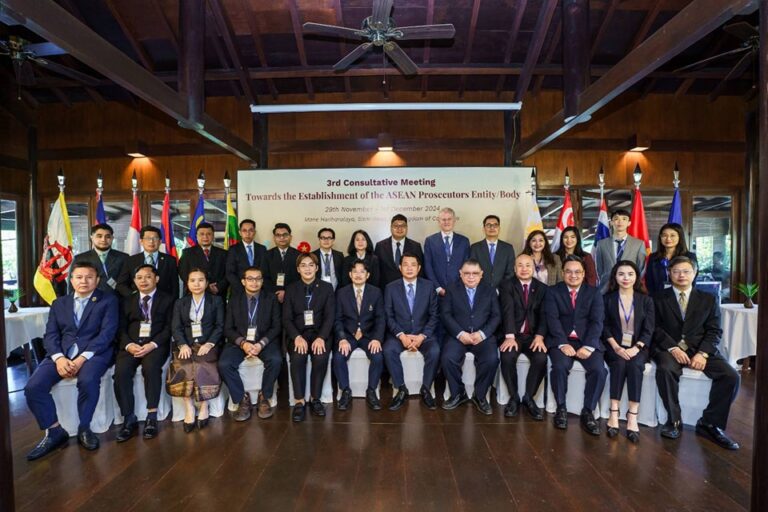
Third Consultative Meeting to Establish the ASEAN Prosecutor Body/Entity
Mr. Jumpon Phansumrit, Deputy Attorney General, along with a delegation from the Office of the Attorney General of Thailand, participated in the Third Consultative Meeting to Establish the ASEAN Prosecutor

